Recent & Forthcoming 5

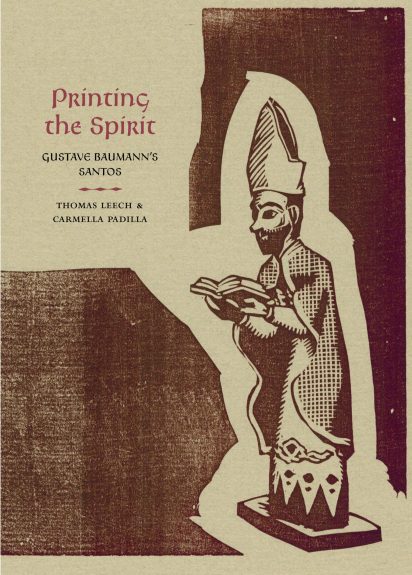
Printing the Spirit: Gustave Baumann’s Santos

Gustave Baumann (1881-1971) was one of the most accomplished and beloved woodcut artists of the twentieth century, and a key figure in the arts scene in Santa Fe for more than fifty years. A prolific artist best known for his enchanting woodblock prints of scenes of southwestern life and culture, he first arrived in New Mexico in 1918, in Taos, at the encouragement of artist Walter Ufer. But after a visit to Santa Fe for an exhibition of prints that he had organized at the newly-opened New Mexico Museum of Fine Arts, he realized that was where he wanted to be. Doors immediately opened for him: the museum’s curator, Paul Walter, secured a small loan and studio space in the basement of the museum, and Baumann quickly became an integral part of the community.

In New Mexico Baumann also discovered a centuries-old tradition of woodcarvings (bultos) and paintings (retablos) featuring saints (santos) along with other religious icons and stories. He was one of the first artists to recognize these woodcarvings as distinct art forms deserving of respect and preservation. In 1927 he was inspired to begin documenting the works of the santeros (literally, wood carvers of saints) who created these unique pieces of art. He began partnering with the writer Mary Austin, author of the now-classic southwestern novel, Land of Little Rain, and a young poet, Peggy Pond Church, who would go on to write the The House at Otowi Bridge: The Story of Edith Warner and Los Alamos, to create texts to complement his woodcuts of saints. His hope was to publish a book on the subject, The Little Saints of New Mexico, and indeed, he completed many of the preliminary elements of the book, but it didn’t come to pass during his lifetime.

In Printing the Spirit, Thomas Leech, former director of the Press at the Palace of the Governors of the New Mexico History Museum, and Carmella Padilla, a cultural historian specializing in New Mexico culture and history, bring together for the first time a selection of Baumann’s renderings of thirty-four bultos and retablos and the proofs he made for the The Little Saints of New Mexico. Also included are color reproductions of some of the actual santos upon which he modeled his works; images of his original carved woodblocks; essays by Baumann and Austin; poetry by Church; and period photographs. The result is a charming and intriguing tale of Baumann’s lifelong efforts to publish the book as well as the complexities of art-making in a multicultural community in his time and ours. 

The story of Baumann’s foray into the santos tradition is a little-known and little-acknowledged aspect of the artist’s luminous career. Printing the Spirit is a testament to Baumann’s unwavering commitment to opening the world’s eyes to the quiet grace and enduring importance of the santo tradition as well as an important contribution to the study of Spanish Colonial art in New Mexico.

Born in Germany in 1881, Gustave Baumann emigrated to Chicago with his family at the age of ten. His career in art began then as well, with the untimely death of his father pushing him into the role of the family breadwinner. Young Gustave was drawn to art, and apprenticed at the Franklin Engraving House, among others. He briefly returned to Germany in 1904-1905 to study woodcarving and graphic arts with Hans Neumann and Maximilian Daso. He returned to the U.S. at the height of the Arts and Crafts Movement, whose emphasis on skill and authenticity greatly influenced his approach to his work. He took great pride in producing all elements of the woodcut print himself, from the original sketch, to carving each color block, and printing the final image. Although his career began as a commercial artist in Chicago, time spent in the art colonies of Indiana, Massachusetts, and New York lured him permanently to fine art. He moved to New Mexico in 1918, and spent the rest of his life in Santa Fe, crafting a vision of the rich cultural diversity, awe-inspiring landscapes, and distinctive architecture of his adopted home that was admired and respected by fellow artists and the public alike.


Thomas Leech is an independent curator, printer and book artist. He is former director of the Press of the Palace of the Governors of the New Mexico History Museum in Santa Fe. Limited editions and books that Leech has printed include Doctor Franklin & Spain, Jack Thorp’s Songs of the Cowboy, O’Keeffe Stories, and The Narrative of the Life of Frederick Douglass (illustrated by Barry Moser). Under Leech’s leadership, the Palace Press received the 2014 Carl Hertzog Award for Excellence in Book Design, the 2015 Edgar Lee Hewett Award from the New Mexico Association of Museums, and the 2013 City of Santa Fe Mayor’s Award for Excellence in the Arts. Between 2001 and 2021 he curated a number of exhibits, including Jack Kerouac and the Writer’s Life and The Saint John’s Bible. Most recently, he is a guest curator of Gustave Baumann: The Artist’s Environment, at the New Mexico Museum of Art on July 18, 2025-through February 1, 2026.

Carmella Padilla is an award-winning journalist, author, and editor who explores intersections in art, culture, and history in the Southwest and beyond. Her books include A Red Like No Other: How Cochineal Colored the World, The Work of Art: Folk Artists in the 21st Century, El Rancho de las Golondrinas: Living History in New Mexico’s La Ciénega Valley, Low ‘n Slow: Lowriding in New Mexico, and The Chile Chronicles: Tales of a New Mexico Harvest. A native Santa Fean, Padilla is a co-founder of the Santa Fe International Literary Festival and a recipient of the Santa Fe Mayor’s Award for Excellence in the Arts and the New Mexico Governor’s Award for Excellence in the Arts.
Sabino’s Map: Life in Chimayó’s Old Plaza

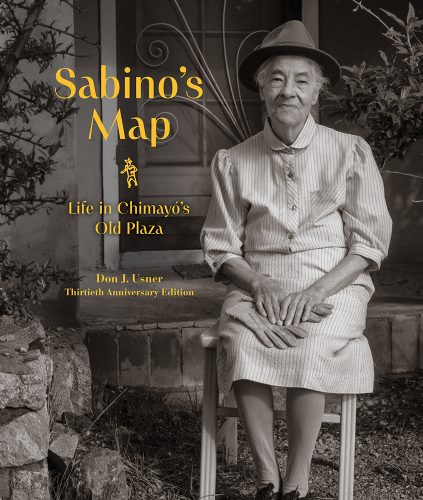
Chimayó, New Mexico is renowned the world over for its Hispano master weaving families, flavorful chile peppers, lowriders, and its fabled church, El Santurio de Chimayó, one of the most visited Catholic shrines and pilgrimage centers in the United States. Not far away lies the Plaza del Cerro, the best preserved Spanish Colonial plaza in New Mexico, and for generations the heart of the village. Locals lived in a tight-knit community and gathered there to pick up mail, socialize, and celebrate religious and family events well into the twentieth century. Although economic forces pulled residents away and led to the plaza’s neglect and near-abandonment after World War II, the memory of the once-vibrant plaza remained vivid in the stories of village elders.

The first edition of Sabino’s Map, published in 1995, documented these oral histories and sparked interest in preserving and revitalizing the plaza. With the help of the Chimayó Cultural Preservation Association and its museum—once the home of the author’s ancestors on the old plaza––Chimayosos and their community have brought new life to the plaza over the last thirty years.

This landmark publication is considered a classic of New Mexico literature, alongside nonfiction works such as William deBuys’s Enchantment and Exploitation: The Life and Hard Times of a New Mexico Mountain Range, Peggy Pond Church’s The House at Otowi Bridge, and Tony Hillerman’s The Spell of New Mexico.

Don J. Usner was born in Embudo, New Mexico, and raised in Los Alamos and Chimayó. A cultural historian, writer, and photographer, he has written and

contributed to numerous books on New Mexico, including Benigna’s Chimayó: Cuentos from the Plaza, Chasing Dichos through Chimayó, Valles Caldera: A New Vision for New Mexico’s National Preserve (with William deBuys), and ¡Órale! Lowrider: Custom Made in New Mexico. Usner is a founding board member of the Chimayó Cultural Preservation Association. He currently lives and works in Santa Fe.

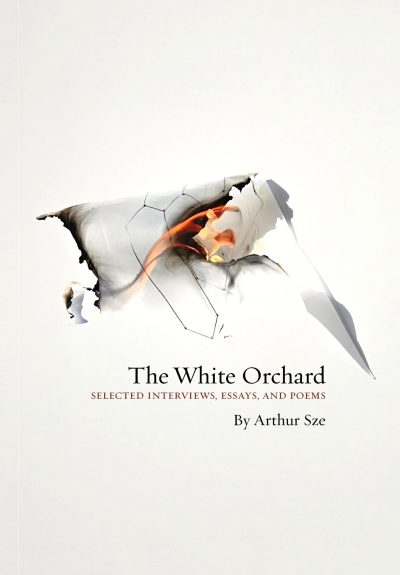
The White Orchard: Selected Interviews, Essays, and Poems

Winner of the 54th Bollingen Prize for Poetry (2025) and the National Book Award, Arthur Sze is one of our finest poets. His creative process comes to light in this illuminating selection of seven interviews, three essays, and poems that examine the evolution of his compositions, his decades teaching poetry, and his deep connection to the cultures and landscapes of New Mexico.

A son of Chinese immigrants who was born and raised in New York City and on Long Island, Sze first studied science at MIT. His call to write poetry pulled him away from that academic pursuit, but the sciences would continue to influence his writing. In 2024, Sze received the National Book Foundation Science + Literature Award for The Glass Constellation: New and Collected Poems (Copper Canyon Press). Sze spent over two decades as an educator, teaching creative writing and poetry to Indigenous students from across America at Santa Fe’s Institute of American Indian Arts (IAIA). In this compilation, Sze is interviewed by his former IAIA student, award-winning Diné poet, editor, and visual artist Esther Belin.

Sze’s fluency in his parents’ native tongue, along with study at the University of California at Berkeley, allowed him to delve into Chinese poetry, both as a student and translator of classical and contemporary works. The White Orchard shows his wider connection to Asian American poetry across the United States and how he has drawn inspiration from translating Chinese poetry into English.

The White Orchard is being released in conjunction with a new book of poems by Sze, Into the Hush, published by Copper Canyon Press.


Arthur Sze is a poet, translator, and teacher. His twelve books of poetry include The Glass Constellation: New and Collected Poems; Sight Lines, winner of the National Book Award; and Compass Rose, a Pulitzer Prize finalist. He is professor emeritus at the Institute of American Indian Arts and was the first poet laureate of Santa Fe. His poems been widely published in magazines including The American Poetry Review, The Atlantic, Best American Poetry, Boston Review, Conjunctions, Harper’s Magazine, Harvard Review, The Kenyon Review, The Nation, The New Republic, The New York Review of Books, The New York Times, The New Yorker, The Paris Review, Poetry The Yale Review, and Pushcart Prize anthologies. Sze’s work has been translated into fifteen languages, and he has given readings internationally in Beijing, Cardiff, Delhi, Havana, Hong Kong, London, Medellín, Paris, Rotterdam, Taipei, and Vilnius. He has lived in New Mexico for over fifty years.

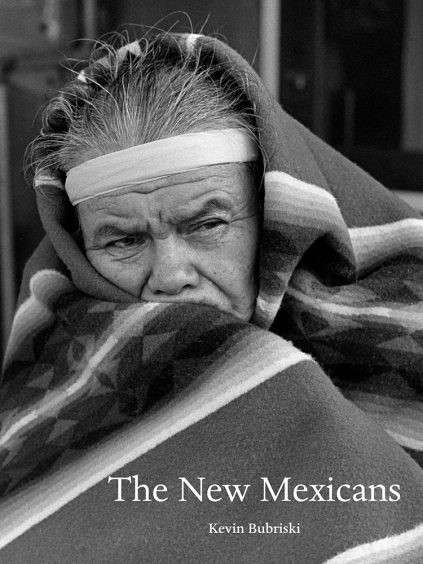
The New Mexicans, 1981–83

A follow-up to Bubriski’s best-selling Look into My Eyes: Nuevomexicanos por Vida, ’81–’83 (Museum of New Mexico Press 2016), which was a photographic documentation of Hispanic New Mexicans, this book expands the lens to include Native Americans and Anglos living in Albuquerque, Santa Fe, and various northern New Mexico villages. There is an insider intimacy to these photographs that portrays a gritty, authentic sense of reality that is neither disturbing nor challenging.

These images are at once timeless as well as deeply evocative of the period, with a universality that will appeal to wider audiences, as more people have discovered the enduring appeal of New Mexico’s unique culture over the last forty-plus years.

“In only two years in the state—time spent mainly in Santa Fe, Albuquerque, and parts north—Kevin Bubriski embraced New Mexico and its people. He photographed everything from tattooed manitos making pilgrimage to the Santuario de Chimayó to traditionally attired Pueblo dancers in ancient plazas, from carefully coiffed politicians courting voters to cowboys in full regalia readying to ride. Even photographs taken inside prison walls are alive with the feisty spirit of the people. For longtime New Mexicans, Bubriski’s photographs brim with nostalgia and ring with a sense of innocence. But undercurrents of historical trauma, social inequity, poverty, and environmental degradation have always haunted the state, and Bubriski’s images reveal shadows here and there: young boys in a bleak concrete flood-control structure with ‘Free Us’ scrawled in graffiti behind them; a heavily burdened man hitchhiking beside the highway on a freezing day; men scavenging through dumpsters; weed-strewn, overgrazed landscapes.

The New Mexicans, 1981–83 will also captivate those not acquainted with the state, providing insight into the eccentricities and cultural richness of northern New Mexico and the diverse characters who call it home.”—Don J. Usner

“Historically, New Mexico’s cultural traditions, peoples, and landscapes have inspired photographers and artists, and Indigenous peoples throughout the Southwest have been some of the most photographed and documented people in the United States. Kevin Bubriski’s photographs of Pueblo dances and ceremonies are part of this long tradition of image making and image taking. With the publication of this book, they become an act of reciprocity, returning to the peoples and communities from which they originated.”—Matthew J. Martinez, from his essay

Kevin Bubriski is a documentary photographer and Guggenheim Fellow whose photographs are in the permanent collections of The San Francisco Museum of Modern Art, the Museum of Modern Art, the Metropolitan Museum of Art, and the Bibliothéque national de France, among others. His books include The Uyghurs: Kashgar before the Catastrophe (George F. Thompson Publishing); Legacy in Stone: Syria before War (powerhouse Books); Pilgrimage: Looking at Ground Zero (powerhouse Books); Nepal: 1975–2011 (Peabody Museum Press and Radius Books); and Portrait of Nepal (Chronicle Books). He lives in Vermont.

Matthew J. Martinez, Ph.D is an educator dedicated to education about and the protection of heritage sites. He previously served as First Lieutenant Governor at Ohkay Owingeh Pueblo and has researched and published in the areas of Pueblo history, documentary filmmaking, and cultural production. Martinez is currently Executive Director of the Mesa Prieta Petroglyph Project, a nonprofit land stewardship organization in northern New Mexico.

Bernard Plossu is a French photographer whose many books include Le voyage mexicain: 1965–1966 (Contrejour); New Mexico Revisited (University of New Mexico Press); ¡Vámonos! Bernard Plossu in Mexico (Aperture); and Western Colors (Thames & Hudson). His work has been widely exhibited around the world and is included in the permanent collections of the Albuquerque Museum, the Center for Creative Photography, Tucson, the Centre Pompidou, Paris, The Museum of Fine Arts, Houston, the San Francisco Museum of Modern Art, and the Institut Valencià d’Art Modern, Valencia, Spain. Born in Vietnam, Plossu lives in La Ciotat, France.

A thirteenth generation New Mexican, Don J. Usner was born in Embudo, New Mexico, and grew up in Los Alamos and in Chimayó. He earned an M.A. in cultural geography at the University of New Mexico and has since written several books, including Sabino’s Map: Life in Chimayó’s Old Plaza; Chasing Dichos Through Chimayó, Benigna’s Chimayó: Cuentos from the Old Plaza; and (with William deBuys) Valles Caldera: A New Vision for New Mexico’s National Preserve. His photographs have appeared in The New Yorker, The New York Times, the Los Angeles Times, Land and People, El Palacio, and New Mexico Magazine, among others. Usner’s writing and photography reflect his long and intimate association with the land and people of Northern New Mexico.

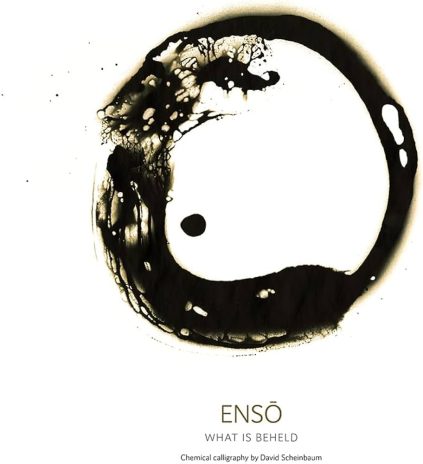
ENSŌ: What is Beheld

For years photographer David Scheinbaum had a desire to create imagery without a camera.  The removal of life’s distractions while quarantining during the COVID pandemic offered him that opportunity. Using only the tools of a Zen calligrapher and darkroom chemistry, he exposed photographic paper, applying fixer or developer or sometimes both under a dim safelight, varying his technique with each image.

This stunning, enigmatic book presents a selection of Scheinbaum’s ensō drawings with an insightful essay by Zen monk and poet Ninso John High and an appreciation by Zen calligrapher, teacher, author, and Buddhist translator Kazuaki Tanahashi. The book includes examples of Tanahashi’s and High’s vibrantly-colored ensōs.  

About the Author

David Scheinbaum is former Director/Chair of the Photography Department and the Marion Center for Photographic Arts at the Santa Fe University of Art and Design, and Professor Emeritus, College of Santa Fe. He is the author of ten books, including most recently, Varanasi: City Immersed in Prayer (George F. Thompson Publishing), and Remnants: Photographs of the Lower East Side (Radius Books) with his wife, Janet Russek. Together they operate Scheinbaum & Russek Ltd., private fine-art photography dealers and consultants in Santa Fe, NM.

Ninzo John High is a poet and zen monk and author of more than a dozen books, including his most recent novel, Scrolls of a Temple Sweeper (Wet Cement Press), and a co-translation of Osip Mandelstam’s poetry (Wesleyan University Press). He was a co-founder and former director of Long Island University-Brooklyn’s MFA program and has taught at universities and facilitated workshops in creative transformation around the world. He lives in Lisbon with his wife, the writer Andrea Clark Libin.

Kazuaki Tanahashi is a painter, calligrapher, Buddhist scholar, and author of six books, including Sky Above: Great Wind: The Life and Poetry of Zen Master Ryokan; Treasury of the True Dharma Eye: Zen Master Dogen’s Shobo Genzo; and Painting Peace: Art in a Time of Global Crisis, all published by Shambala. He is also director of the international peace organization A World Without Armies.

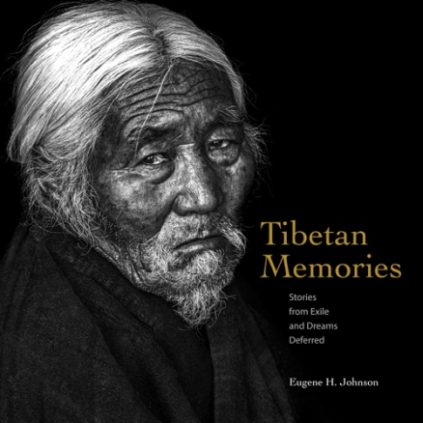
Tibetan Memories: Stories From Exile and Dreams Deferred

This is the first book to present the stories of ordinary Tibetan women and men in exile, in their own words, and the first with compelling portraits of the individuals featured––47 in all––along with gorgeous black-and-white photographs of the lands they embraced in Ladakh, where they fled after the Chinese annexed their homeland in 1959.

To meet the people and make these photographs, the Johnsons traveled throughout Ladakh, visiting many villages, and interviewing dozens of people. Most of them had to leave everything behind when they fled: family, friends, and often their most precious possessions: their animals, with whom they had a unique and symbiotic relationship.

The situation of the Tibetan refugees in Ladakh, and indeed, in the rest of India, which has the highest concentration of Tibetan refugees, is particularly heartbreaking as well as challenging. They cannot become citizens, own land or property, or travel freely internationally or even throughout India. They also are excluded from government or other public jobs.

Yet, as Dr. Johnson reveals in his photographs and stories, these refugees are, every one, remarkably resilient, wise, and hopeful. They have made their tragedy a source of strength, along with their unwavering devotion to their spiritual leader, the Dalai Lama, and to their Buddhist practice, which continues to sustain them. They maintain their belief that Tibet will one day be free, believing that losing that hope would be the ultimate disaster. 

In a world full of exiles, 150,000 of which are Tibetan, this book is not only of historical significance, it is timely. It puts a human face on the increasingly complex and growing problem of people being forcibly displaced from their homelands––as many as 110 million according to a recent U.N. study. These remarkable individuals show us the meaning of hope and of never giving up. They also show us that every human being deserves compassion, for without it, the future of humanity stands in peril.

About the Author

Dr. Eugene H. Johnson has been Professor of Comparative Medicine at Sultan Qaboos University in Oman since 2000. Prior to that appointment, he worked as a National Institutes of Health Clinical Research Scientist at the Yale University Medical School. He has mentored numerous students and research scientists from many parts of the world

and written over one hundred and fifty peer-reviewed scientific articles. A passionate photographer, he is the author of four books: A Photographic Pilgrimage, Something’s Fishy, (Unspoken Dialogues, 2004) and a two-volume series commissioned by the late Sultan Qaboos bin Said of Oman, Reflections from the Not So Distant Past in Oman. His work has been featured in a number of magazines including Lenswork, Black and White Photography, Food and Travel, Iris Foto, Estado de Sao Paulo, Docubooks, and Whimsical Magazine, and in books such as Looking at Images by Brooks Jensen, the longtime editor of Lenswork. His work is held in numerous private and public collections including the Museum of Art in Sao Paulo, Brazil; Nairobi National Museum, Kenya; Banco do Brasil, Brazil; Brazilian American Cultural Institute, Washington, D.C.; Al-Bustan Palace, Oman; and the Royal Court of the Sultanate of Oman.

About the Contributor

Mirasol Delfin Johnson was born in the Rizal province of the Philippines and pursued her education at Roosevelt College in Manila and AMA University, Quezon City, Philippines, where she studied commerce and computer science. In 1988, she relocated to Norway, initially working with bilingual and half-Filipino-Norwegian children at the Educational and Learning Development Center in Oslo, and later becoming a representative for bilingual assistants from various countries as well as a legal interpreter and translator within both the judicial system and medical establishments. Her multifaceted cultural background has been invaluable in her role as the Associate Director of Unspoken Dialogues, a non-profit organization she co-founded with her husband, Eugene Johnson, to promote narrative photographic imagery that conveys universal themes of humanity. Proceeds from the sale of prints and books are donated for educational and child health development programs.

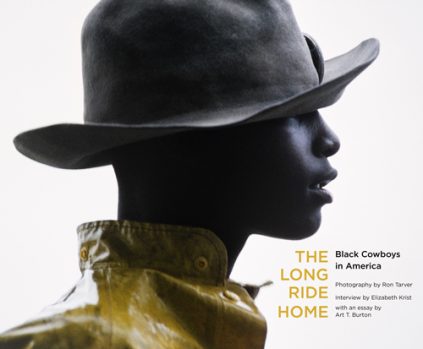
The Long Ride Home: Black Cowboys in America

The only book to tell the story of the contemporary Black cowboy experience––and the only one to feature photographs––The Long Ride Home presents over 100 color and black-and-white images that convey the beauty, romance, and visual poetry of this way of life and its rich heritage. Although Black cowboys have long been a fixture on the American landscape, few people are aware of their enduring contributions to western history and the settlement of the frontier and of their unique culture that continues to thrive today in urban as well as rural areas all over the country.

The Long Ride Home contains beautiful, compelling, and often surprising contemporary images of African-American cowboy culture that affirm a thriving culture of Black-owned ranches and rodeo operations, parades, inner-city cowboys and retired cowhands––and Black cowgirls of all ages, too. Viewed together they question our long-held notions of what it means to be a cowboy, and with that, what it means to be an American.

The Long Ride Home couldn’t be more timely, coming as it does on the heels of Beyoncé’s hit album, Cowboy Carter (2024) and Idris Elba’s Concrete Cowboy (2021). Elba’s film was based on Greg Neri’s 2013 book, Ghetto Cowboy, about contemporary African-American cowboy culture of Philadelphia and was shot in some of the same neighborhoods where Tarver also made images.

In addition to Tarver’s beautiful and compelling photographs, The Long Ride Home includes an essay by Art. T. Burton, an expert on the history of Black cowboys. This book is both a tribute to and celebration of the Black cowboy in America and provides an invaluable and unique perspective on American culture and history as well as the Black experience in America.

About the Author
Ron Tarver comes from a family of African American cowboys. He grew up in Fort Gibson, a small agricultural community in rural northeastern Oklahoma. His grandfather, a member of the Black Freedman of the Cherokee Tribe, was a working cowboy during the 1940s, and Tarver spent many long, hot summer days hauling hay and working on local farms and ranches, occasionally rounding up stray cows. Tarver has distinguished himself in the field of fine-art photography. In 2021, he was awarded a John Simon Guggenheim Memorial Foundation Fellowship, in Creative Arts Photography and he has been in more than thirty solo and eighty group exhibitions. His photographs are also in numerous collections, including the National Museum of American Art of the Smithsonian Institution, Oklahoma History Center, Philadelphia Museum of Art, State Museum of Pennsylvania, and Studio Museum in Harlem. As a long-time staff photographer for The Philadelphia Inquirer, he shared the 2012 Pulitzer Prize for his work on a series documenting school violence in the Philadelphia public school system, was nominated for three additional Pulitzers, and was honored with awards from World Press Photos and the Sigma Delta Chi Award of the Society of Professional Journalists. Tarver is currently Associate Professor of Art at Swarthmore College. He is co-author, with journalist Yvonne Latty, of We Were There: Voices of African-American Veteran from World War II to the War in Iraq (Harper Collins, 2004), which was accompanied by a traveling exhibition that debuted at the National Constitution Center in Philadelphia.

About the Contributor
Art T. Burton retired in 2015 after spending thirty-eight years in higher education as a professor of history at Prairie State College and South Suburban College and as an administrator in African-American Student Affairs at Benedictine University, Loyola University Chicago and Columbia College Chicago. He is the author of several groundbreaking books on African-American history in the West, most recently Cherokee Bill: Black Cowboy-Indian Outlaw (Eakins Press, 2020) and Black Gun, Silver Star: The Life and Legend of Frontier Marshal Bass Reeves (Bison Books, 2022).

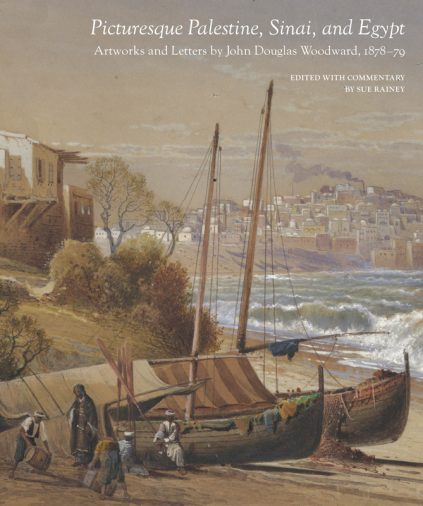
Picturesque Palestine, Sinai and Egypt: Artworks and Letters by John Douglas Woodward, 1878–1879

This book is a beautiful and engaging presentation of drawings and letters by John Douglas Woodward (1846–1924), a prominent American artist/illustrator during the [1870s and 1880s. He was on assignment for New York publisher D. Appleton and Co. to make on-the-spot drawings for illustrations for Picturesque Palestine, Sinai and Egypt (1881–1883), which has been called the most important book of illustrations of the region of its time. Some 200 of his compositions appeared in the book as wood engravings, the least expensive mass media of the time, while he contributed the art for 13 steel engravings. Woodward traveled with the somewhat older and better-known artist, Harry Fenn, who was the lead artist for the very successful Picturesque America, published by D. Appleton in parts from 1872–1874. Woodward was the second most prolific contributor to Picturesque America and, like Fenn, also travelled and drew for Picturesque Europe (1878–1879). 

Woodward’s travels for Picturesque Palestine yielded a treasure trove of unique historical art and correspondence. Most drawings for book and magazine illustrations during this period were discarded by the artist after the printing plates were made. But Woodward saved his, providing a visual record, often in full color, of the region, in addition to the black-and-white illustrations in the book. In presenting them alongside his lively, engaging letters, this book will appeal to those interested in the history and art of the Middle East as well as in the appearance of places of importance mentioned in the Holy Bible and the specifics of travel to the region during the 1870s, when there was almost no tourist infrastructure and limited knowledge of other cultures.

Although Picturesque Palestine is well-known to scholars and connoisseurs and available in some libraries and on-line, Woodward’s drawings and letters recording his trip to Palestine are not. The exquisite drawings, rendered in pencil, watercolor, and gouache, belong to the Episcopal Diocese of Virginia and have been stored since 1941 at Shrine Mont, a conference center in Virginia’s Shenandoah Valley (founded by the artist’s nephew). The letters to his wife and mother belong to Shrine Mont, a retreat and conference center in Virginia’s Shenandoah Valley founded by the artist’s nephew, where thy have been stored since 1941. The Letters to his wife and mother are in the collection of the Valentine History Museum in Richmond.

About the Author:
Sue Rainey is an esteemed scholar who has focused her research and writing on artists who prepared book and magazine illustrations in the latter half of the nineteenth century, especially John Douglas Woodward and Harry Fenn. Her Creating Picturesque America: Monument to the Natural and Cultural Landscape (Applewood Books (1994 & 2001) was the first study of that landmark 1872-74 publication and won the 1997 Charles C. Eldredge Prize of the National Museum of American Art (Smithsonian) for Distinguished Scholarship in American Art.

In 1997 she and Roger B. Stein curated an exhibit of Woodward’s work at the University of Virginia’s art museum, whose catalog, Shaping the Landscape Image, 1865-1910; John Douglas Woodward (Bayly Art Museum/University of Virginia 1997) won the Award for an Outstanding Publication of the American Historical Print Collectors Society, as did her Creating a World on Paper: Harry Fenn’s Career in Art(Studies in Print Culture and the History of the Book) (University of Massachusetts Press 2013). For over thirty years, Rainey has served as volunteer curator of the Woodward collection owned by Shrine Mont, an Episcopal conference center in Orkney Springs, Virginia.

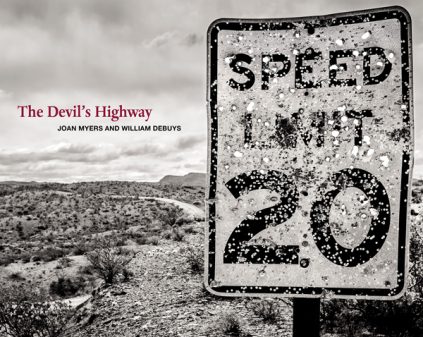
The Devil’s Highway

With this haunting new collection of photographs, Joan Myers continues the decades-long journey she began in Where the Buffalo Roamed (with Lucy Lippard), documenting the changing landscape and culture of the American West. The images in this new collection are more personal, more elegiac––and all black-and-white. They bear witness to the slow fracturing of the American Dream, the demise of cowboy culture, and the shrinking of small towns, ranches, and farms throughout western rural America.

The themes she examines are reflected in Devil’s Highway, a powerfully evocative short story by Pulitzer finalist William deBuys, first published in1992 in Story magazine and reproduced again here for the first time. It is as evocative of the social and visual landscapes of the rural West now as when it originally appeared—perhaps more so, touching as it does on the harsh realities of the lives of undocumented workers and other denizens of the border struggling to survive. Myers and deBuys previously collaborated on Salt Dreams: Land and Water in Low-Down California, which inspired the highly acclaimed film, The Colorado.

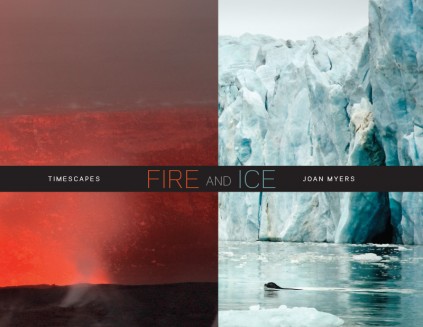
 Joan Myers has been photographing for more than forty-five years. Her highly acclaimed work has been the subject of three Smithsonian exhibitions, more than fifty solo and eight group shows, and eleven books, including Where the Buffalo Roamed (Damiani 2019), Fire & Ice: Timescapes, with Kathleen Dean Howe (Damiani 2015), and Wondrous Cold: An Antarctic Journey (Smithsonian Books 2006). She has spent much of her time roaming the American West, but has also worked in India, the Canary Islands, Antarctica, Java, Sicily, Sardinia, Hawaii, and elsewhere. Her extensive photo archive is now housed at the Briscoe Center for American History on the University of Texas campus.

William deBuys is a Pulitzer Prize non-fiction finalist, a 2008-2009 Guggenheim fellow, and the author of ten books, the most recent of which is The Trail to Kanjiroba: Rediscovering Earth in an Age of Loss, (Seven Stories Press 2021). He has collaborated on two previous books with Joan Myers, The Jungle at the Door (George F. Thompson 2012), and Salt Dreams: Land and Water in Low-Down California, (University of New Mexico Press 1999), which inspired the highly acclaimed film, The Colorado, which premiered at the Metropolitan Museum of Art in 2015. The recipient of a 2008–2009 Guggenheim Fellowship, he lives in northern New Mexico.

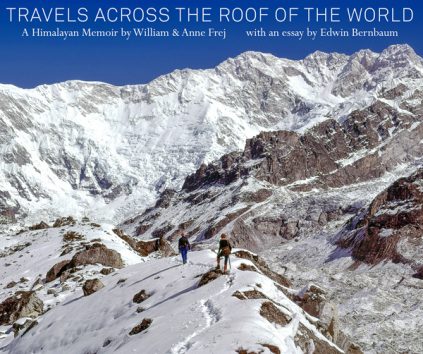
Travels Across the Roof of the World: A Himalayan Memoir

TRAVELS ACROSS THE ROOF OF THE WORLD provides a sweeping yet intimate view of the breathtaking peaks, splendid valleys, and extraordinary people of this vast region, from the Pamir Mountains in Kyrgyzstan, through Afghanistan’s fabled Hindu Kush, the Karakoram in Pakistan, and the Great Himalaya Range that stretches across northern India, Nepal, Tibet, and Bhutan.

Unique in scope among photo books on the Himalaya, TRAVELS ACROSS THE ROOF OF THE WORLD chronicles William and Anne Frej’s more than twenty pilgrimages throughout the area spanning 40 years and 3,000-miles through some of the world’s most remote and difficult-to-reach country. Inspired by the devotion to the practice of Tibetan Buddhism they encountered in the villagers they met on their first trek to Nepal in 1981, they set out on a quest to document Asia’s highest peaks as well as the lives of the resilient people living in these remote mountain fastnesses.

When they began, trekkers from the West through these regions were few. Even now, the trips are demanding––but not nearly as harsh as the daily lives of the residents, who continue to exist in a kind of stunning isolation that has allowed them to maintain the rich cultural traditions and spiritual practices that have sustained them over many centuries. Edwin Bernbaum’s essay rounds out the picture, with its focus on the symbolism, religious importance, and associated legends of these sacred places.

ABOUT THE AUTHORS

William Frej has been photographing indigenous people for over forty years, while living in Indonesia, Poland, Kazakhstan, and Afghanistan, as well as other remote, mountainous regions of Asia as a career diplomat with the United States Agency for International Development (USAID). His first two books, Maya Ruins Revisited: In the Footsteps of Teobert Maler (Peyton Wright Gallery Press 2020), have won more than a dozen awards between them (see their listings elsewhere on this website). His work has been shown at the San Francisco Arts Center, San Francisco International Arts Festival, Galeria La Eskalera in Mérida, Mexico, and Peyton Wright Gallery, Peters Projects/Gerald Peters Contemporary, and Museum of Spanish Colonial Art in Santa Fe, New Mexico. His images are in the Duke, Notre Dame, Stanford, University of California, Berkeley, University of New Mexico, and Yale. His photographs of Africa, the Himalaya, and India are featured in Sacred Mountains of the World, by Edwin Bernbaum (Cambridge University Press, 2022).

Anne Frej is a retired urban planner who focused on feasibility studies and design concepts for commercial real estate projects in the U.S., Indonesia, Central Europe, and Central Asia. At the Urban Land Institute (ULI) in Washington, D.C., she was the project director and primary contributor to four books published by the Institute. She also served as the Asia editor of Urban Land, a monthly magazine published by ULI. At the U.S. Embassy in Kabul, Afghanistan, she was as a cultural-resources planner responsible for community-outreach programs and cultural-heritage activities. She was a contributor to Trekking in Nepal, West Tibet and Bhutan, by Hugh Swift (Sierra Club Books 1989).

Edwin Bernbaum, Ph.D., is a mountaineer and scholar of comparative religion and mythology. He is the author of Sacred Mountains of the World, 2nd edition (Cambridge University Press 2022), the first edition of which won the Commonwealth Club of California’s gold medal for best work of nonfiction, and The Way to Shambala: A Search for the Mythical Kingdom Beyond the Himalayas (Shambala 2001), a study of Tibetan myths and legends of hidden valleys and their symbolism. He is featured in “Beyond the Mountaintops: Extraordinary Mountaineers, Extraordinary People,” an exhibit at the American Mountaineering Museum on eight climbers who have pioneered advances in climbing and humankind. Currently he is Co-Chair of the International Union for the Conservation of Nature (IUCN) Group on the Cultural and Spiritual Values of Protected Areas (CVSPA) and Senior Fellow at the Instituto de Montaña, which helps Andean communities become more resilient as they adapt to climate change.

Jane Gray Morrison is an ecologist, author, and filmmaker who currently serves as the executive vice president of the Dancing Star Foundation (dancingstarfoundation.org), a non-profit organization focused on international biodiversity conservation, global environmental education, and animal protection. Her most recent books are On the Nature of Ecological Paradox (Springer, 2021), with Michael Tobias, and Bhutan: Conservation and Environmental Protection in the Himalayas (Springer, 2021) with Michael Tobias and Ugyen Tshewang, former secretary of Bhutan’s National Environment Commission.

Michael Tobias, Ph.D, is a global ecologist, author, and filmmaker who currently is president of the Dancing Star Foundation (dancingstarfoundation.org). The author of some sixty books of non-fiction and fiction, and the writer/director/producer of more than 100 films, Tobias did much of his Ph.D research in Ladakh, India, and has explored mountain ranges on every continent. He received the Courage of Conscience Award in 1996, an honor also bestowed on His Holiness the 14th Dalai Lama and Mikhail Gorbachev, among others, and the 2004 Parabola Magazine Focus Award.

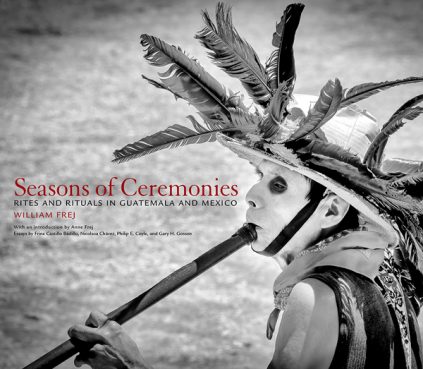
Seasons of Ceremonies: Rites and Rituals in Mexico and Guatemala

“This remarkable collection of photographs and scholarship brings together the mystical with the visual in a mesmerizing blend. In Frej’s skilled hands, the magic of photography and of Mesoamerican ritual conspire to transport the reader, not with voyeuristic diversion but with dreamlike captivation.
The essays add a dimension that presents the same intertwining of fact and mystery. As the pithy writings make amply clear, the transcendent practices represented are deeply rooted in the earth and express a powerful syncretism of Indigenous animism and Catholicism. The words and images together vividly demonstrate the purpose of the ritual performances: to give meaning to a world that often presents chaos and uncertainty. What a powerful concept for our times.”
—Don J. Usner, photographer and author of Sabino’s Map: Life in Chimayó’s Old Plaza, Chasing Dichos Through Chimayó, and, with William deBuys, Valles Caldera: A Vision for New Mexico’s National Preserve.

William Frej began his career as an architect. He later served as a career diplomat with the Agency for International Development, living in Nepal, India, Indonesia, Poland, Kazakhstan, Afghanistan and, most recently, Mexico, over a period of thirty-four years. Always with his camera at his side, he has been photographing Indigenous people and their environments since the 1970s, documenting the changing lifestyles and architecture of many of the world’s unique and ancient cultures. He lives in Santa Fe. 

Seasons of Ceremonies Frej

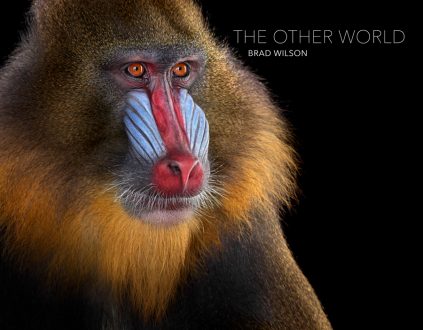
The Other World: Animal Portraits

This stunning new collection of photographs by Brad Wilson is inspired by the notion of the “authentic encounter,” that is, allowing the animal to reveal itself to us rather than imposing our subjective notions on it or on the picture.

Wilson works in cooperation with zoos and wildlife sanctuaries who bring the animals into the studio, where he photographs them against a black background. This makes the animals appear grounded and three-dimensional—magnificent, approachable, yet inherently mysterious. He describes the situation as a kind of “controlled chaos,” but in the end it allows him to create images that show each animal as an individual being with its own personality and dignity. There is no whiff of anthropomorphism here but rather a wise and respectful approach to these creatures with whom we share the Earth.

As Wilson says, “In each animal’s gaze we see a part of ourselves and catch a fleeting glimpse of another world, a world we once fully inhabited. In many ways they are what we used to be, and like us, they deserve to follow their own unique path into the future, wherever it may lead them. Their fate is fundamentally tied to our own and we must realize that our ascendency can no longer continue at their. Conservation is now vitally important, not just to save animals, but to save ourselves.”


Brad Wilson is a fine art and commercial photographer whose images have appeared around the world in advertising campaigns, annual reports, music packages, and in media ranging from CBS News to Audubon. His fine-art photographs have been shown in museums, galleries, and fairs in London, Paris, New York, Brussels, Copenhagen, Moscow, Beijing, Singapore,Tokyo, and Santa Fe. He is currently represented by Doinel Gallery in London, Surround Art Gallery in Moscow, Artistics Gallery in Paris, and PhotoEye Gallery in Santa Fe. Wilson is based in Santa Fe, NM, where he pursues his photography surrounded by the beauty and tranquility of the southwestern deserts.

Dan Flores is the author of ten books, most recently the New York Times bestseller, Coyote America: A Natural and Supernatural History (Basic Books 2016), and American Serengeti: The Last Big Animals of the Great Plains (University Press of Kansas 2016). Pulitzer-winning novelist Annie Proulx has written that “his work ranks with that of Thoreau, William Bartram, Aldo Leopold, John Muir, Peter Matthiessen.” Flores’s essays on the environment, art, and culture of the West have appeared in The New York Times, the Los Angeles Times, and the Chicago Tribune, as well as in Texas Monthly, Orion, Wild West, and Southwest Art. Flores is A. B. Hammond Professor Emeritus of the History of the American West at the University of Montana-Missoula. He lives outside Santa Fe, New Mexico.


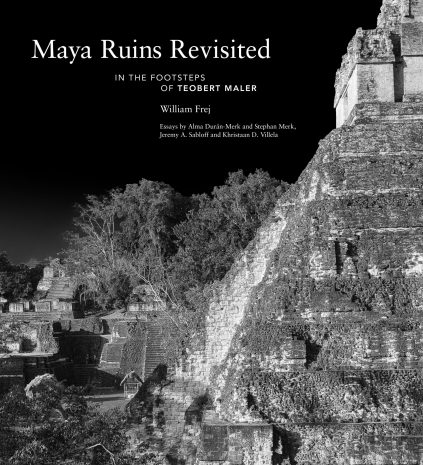
Maya Ruins Revisited: In the Footsteps of Teobert Maler

Winner of twelve awards, including:
2022 Independent Press Gold Award for Photography
2021 Foreword Indies Gold Award for Best Photography Book & Honorable Mention for Best Coffee Table Book
Silver 2021 IPPY (Independent Publisher’s Award): Photography
15th Annual National Indie Excellence Award for Photography (2021)
2021 New Mexico/Arizona Book Award for Best book in Anthropology

“Maya Ruins Revisited: In the Footsteps of Teobert Maler, by William Frej, is a truly outstanding and magnificent book, on many levels. In the late nineteenth and early twentieth century, a remarkable photographer named Teobert Maler explored large areas of Guatemala and the Yucatán, discovering hundreds of unknown Maya temples and cities and photographing what he found. These photographs were not only extraordinary for their artistic brilliance, but they created an important record of what these Maya ruins looked like unrestored and unexcavated, still buried in jungle growth. Now, over a century later, William Frej has retraced the explorations of Maler and photographed many of his sites, often from the same vantage points. The result is a gorgeous and haunting book of photography, exploration, history, and adventure, enriched by essays from several well-known Maya scholars. While some of these Maya sites have been cleared, many remain untouched, remote, and almost unknown, visited only by Maya beekeepers. I highly recommend this fascinating and beautiful volume, which is sure to become a classic.”
–Douglas Preston, #1 New York Times bestselling author of The Lost City of the Monkey God

“If you read only one work of art about explorer-photographers of Pre-Columbian Maya ruins, my advice is to make it this extraordinary compilation. This is much more than a rephotography book. Yes, it compares William Frej’s glorious contemporary images of remote ruins alongside the late nineteenth-century images of archaeologist-adventurer Teobert Maler, but the aesthetic pleasures are augmented by detailed knowledge with beautifully written, informative captions and current scholarship. Best of all, you can travel from your armchair through history and don’t have to brave the jungle heat, snakes, and insects.”
–MaLin Wilson-Powell, former assistant to Beaumont Newhall, former curator at the New Mexico Museum of Art, Santa Fe, the McNay Art Museum, San Antonio, Texas, and former director of The Raymond Jonson Gallery at the University of New Mexico.

This stunning, substantial volume documents William Frej’s forty-five year search for remote Maya sites primarily in Guatemala and Mexico, inspired in large part by his discovery of the work of German-Austrian explorer Teobert Maler, who photographed them in the late nineteenth and early twentieth centuries. Many of Frej’s magnificent photographs are juxtaposed here with historic photographs taken by Maler, and reveal the changes in the landscape that have occurred in the intervening century.

This unique pairing of archival material with current imagery of the same locations will be a significant addition to the literature on this ancient civilization that continues to captivate scholars and general readers alike. The book provides extended captions for all of the photographs, including their historical context in relation to Maler’s images, which are archived at the Peabody Museum of Archaeology and Ethnology at Harvard University, the Ibero-American Institute in Berlin, Brigham Young University, the University of New Mexico, and the Getty Museum in Los Angeles.

The author’s introduction covers the challenges of finding and photographing remote Maya sites. Alma Durán-Merk and Stephan Merk contribute a biographical sketch of Teobert Maler, while Khristaan Villela addresses the historic role of photography as a tool for documenting and presenting the history of significant Maya sites. Jeremy Sabloff provides essential background on the Maya and their built environment, and a chronology of the principal periods of Maya culture. The book includes a listing of all the sites featured and their locations as well as two maps.

With 160 dutone and triton images, Maya Ruins Revisited offers an engaging and stimulating visual journey to many remote and seldom-seen Maya sites. It will serve as valuable documentation of places that are rapidly being overcome by forces of nature and man.

William Frej has spent decades photographing remote cultures around the world while living in Indonesia, Poland, Kazakhstan, and Afghanistan, as well as other remote, mountainous regions of Asia. He has visited over 180 Maya archaeological sites in Mexico and Guatemala, over half of which were first photographed by Teobert Maler. His work has been featured in a number of venues in the United States and Mexico.

Alma Durán-Merk has published extensively in the field of migration ethno-history. Her books include In Our Sphere of Life: German-Speaking Immigrants in Yucatán and their Descendants, 1876-1914, and Villa Carlota: German Settlements in Yucatán, 1864-1897.

Stephan Merk is considered one of the foremost experts on Teobert Maler. He has written two books about Maya Puuc architecture, and has served as a co-editor of Mexicon – Journal of Mesoamerican Studies since 1998.

Khristaan D. Villela is the Director of the Museum of International Folk Art, Santa Fe, New Mexico. He specializes in the history of Pre-Columbian and Latin American art and on the reception of ancient American culture in the modern world, and is the author, most recently, of Ancient Civilizations of the Americas: Man, Nature, and Spirit in Pre-Columbian Art (Miho Museum, 2011).

Jeremy A. Sabloff is an archaeologist with a specialty in ancient Maya civilization. He is an external professor and past president of the Santa Fe Institute and the Christopher H. Browne Distinguished Professor of Anthropology, Emeritus, at the University of Pennsylvania. He is the author or co-author of ten books and monographs, as well as the editor or co-editor of fourteen books.

Frej

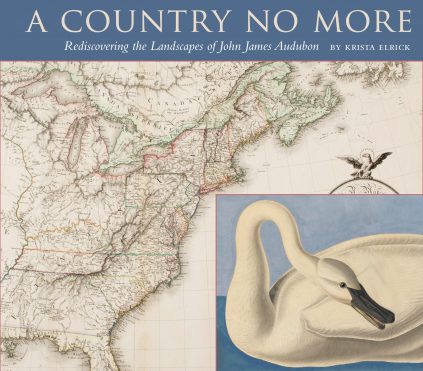
A Country No More:
Rediscovering the Landscapes of John James Audubon

In 2010, when photographer Krista Elrick began traversing John James Audubon country in search of the birds the nineteenth-century American naturalist observed, painted, and wrote about, she encountered scarcely a sighting. Instead, she found the lushly forested watersheds and waterways that Audubon had passionately described in his journals vastly altered with many of the bird species extinct, their supporting habitat all but disappeared. Industrial buildings, parking lots, and strip malls had overtaken much of the area, edging out the natural world.

Vintage Hasselblad film camera in hand, she traveled for 10 years and over 45,000 miles as she sought clues to what had happened to these places and to the animals––and peoples––that had once lived there. Starting in Mill Grove, near Philadelphia, she retraced Audubon’s journeys to the bluffs of Cincinnati overlooking the Ohio River, to Henderson, Kentucky, to the confluence of the Ohio and Mississippi Rivers, to Natchez, Mississippi, St. Francisville and New Orleans, Louisiana, to Charleston, South Carolina, to St. Augustine and Key West, Florida, to the confluence of the Missouri and Yellowstone Rivers, and, finally, to Audubon’s gravesite in the Trinity Church Cemetery in New York City.

She responded to his paintings of birds that had been constructed with backdrops from a variety of locales by creating collages of her own black-and-white images of the regions she traveled through. She pored over historic bank notes, period maps, and other ephemera that yielded fascinating insights into the changes and the resulting effects on the natural world and its species, as well as on the lives of the Native American and African American populations that had occupied the areas.

In her research she also discovered that Audubon himself was something of an enigma, a fabulist who told conflicting stories about his own history and identity. The result is a fascinating compendium that gives us a fresh and provocative perspective on Audubon, the man, his times, and his legacy.

Krista Elrick has been an exhibiting artist and activist for more than three decades. A Country No More: Rediscovering the Landscapes of John James Audubon is her first solo book. Several of the collages she created for this project were featured in a solo exhibition entitled “Retracing Audubon,” at Northlight Gallery in Tempe, Arizona, in 2019, and will be the focus of a solo show at the Turchin Gallery at Appalachian State University in Boone, North Carolina, which opens in 2021. Elrick’s work has appeared in other books including Imagine a City that Remembers: The Albuquerque Rephotographic Project, by Anthony Anella and Mark Childs (University of New Mexico Press, 2018); Grasslands / Separating Species, with photographs by Dana Fritz, David Taylor, Jo Whaley and Michael Berman, and essays by Mary Anne Redding, William deBuys, and Rebecca Solnit (Radius Books 2010), and which was published in conjunction with an exhibition at 516 ARTS in Albuquerque; and Through the Lens Creating Santa Fe (Museum of New Mexico Press 2009), which she co-edited with Mary Anne Redding. Elrick lives in Santa Fe, New Mexico.

Elrick

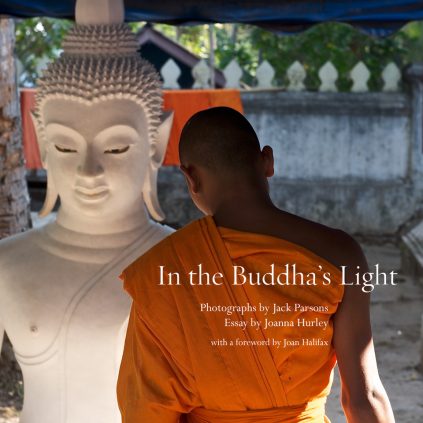
In the Buddha’s Light: The Temples of Luang Prabang

This engaging memoir takes the reader on a journey into the heart of one of Southeast Asia’s most beautiful and enchanting small cities. Lush, exotic––and full of contradictions––Luang Prabang sits at the confluence of the Mekong and Nam Khan Rivers in Laos. Formerly the capital of the ancient royal kingdom of Lane Xang, “home of 1000 elephants,” it is now a World Heritage site that hosts nearly half a million visitors a year. It is also home to more than 35 Buddhist temples, and the center of spiritual life in a communist country that is the most-bombed place in history courtesy of the U.S. military during the Vietnam War. The American authors found the Lao people charming and gracious in spite of this atrocity, and more than willing to welcome them into their homes and magnificent temples.

Beautifully illustrated with 75 color images.

Award-winning photographer Jack Parsons is most famous for his elegant book photography that captures the visual heritage of the American Southwest. He has published some seventeen books, including the iconic Santa Fe Style (Rizzoli), with Christine Mather and Sharon Woods, and Lone Star Living (Bulfinch Press), with the late Tyler Beard. www.jackparsonsdigital.com

Joanna Hurley has spent her career in book publishing. Currently an agent/producer of art and photography books, she is based in Santa Fe, New Mexico.

Roshi Joan Halifax, Ph.D, is a Buddhist teacher, Zen priest, and anthropologist. Her most recent book is Standing at the Edge: Finding Freedom Where Fear and Courage Meet (Flatiron Books). She is the founder, abbot, and head teacher of Upaya Institute and Zen Center in Santa Fe, New Mexico. https://www.upaya.org

In the Buddha's Light

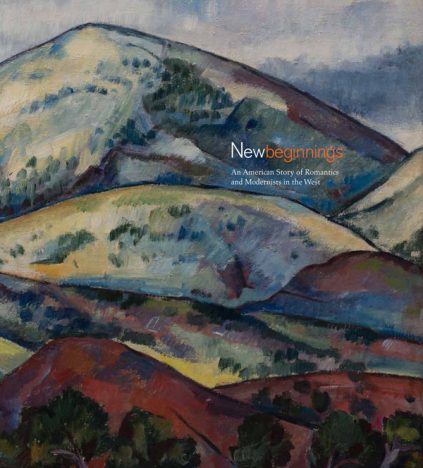
New Beginnings: An American Story of Romantics and Modernists in the West

Santa Fe and Taos were among the most important national and international art communities during the 1920s and 1930s; this book explores their similarities, differences, and connections. Legions of American and European artists found new beginnings in the physical and cultural landscapes of northern New Mexico, resulting in a new and deeply rooted orientation for modern art in America.

Produced on the occasion of the New Beginnings traveling exhibition, this lavishly illustrated catalogue presents 111 objects by 72 artists from the Tia Collection, including paintings, drawings, prints, photographs, and sculptures. To encourage a fresh view of the shift from representation to diverse branches of Modernism, the artworks are grouped into three sections: by the four seasons, by the vibrant mixture of Native American, Hispano and Anglo themes, and by studio made still-lifes and portraits. Work by artists such as Ernest L. Blumenschein, E. Irving Couse, Stuart Davis, Leon Gaspard, Robert Henri, John Marin, John Sloan, and Walter Ufer are juxtaposed with lesser known or virtually unknown works by William Verplanck Birney, Richard Crisler, Katherine Levin Farrell, Jan Matulka, Arthur Musgrave, Polia Pillin, and Beulah Stevenson.

The exhibition will travel to the Scottsdale Museum of the West, Scottsdale, Arizona; Booth Western Art Museum Cartersville, Georgia; Dayton Art Institute, Dayton, Ohio; Crocker Art Museum, Sacramento, California; the Yellowstone Art Museum, Billings, Montana, and the Cowboy Hall of Fame in Oklahoma City, Oklahoma.


Laura Finlay Smith is the curator of The Tia Collection.

MaLin Wilson-Powell has served as curator of the New Mexico Museum of Art in Santa Fe, and the McNay Art Museum in San Antonio, Texas, as well as director of the Jonson Gallery at the University Art Museum in Albuquerque, New Mexico. She is an independent curator and author of numerous publications, including Mabel Dodge Luhan and Company: American Moderns and the West (Museum of New Mexico Press 2016), which she co-edited with Lois Rudnick.

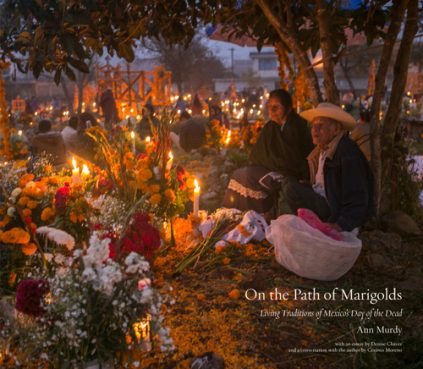
On the Path of Marigolds:
Living Traditions of México’s Day of the Dead

Photographer Ann Murdy has been documenting the celebrations around Day of the Dead (Día de los Muertos) in México for more than 20 years. A native of Los Angeles, she first started collecting Chicano art in the 1990s, and was drawn to México by the vibrancy of its culture and traditions. She loved the rich color she found everywhere, from the brilliant red and pink of the flowers adorning the ofrendas or altars to the dead, to the dusky yellow of the marigolds lining the ofrendas and the pathways to them, whether in private homes or cemeteries.

As she shows in her hauntingly beautiful images, in México, death is considered a part of life, something to be celebrated, not feared. El día de los muertos (which actually lasts two days, November 1-2), is a time to gather with friends and families to feast, pray, dance, and honor the lives of those who have died. This lovely volume gathers 90 of her most stunning images of celebrations from three villages, Teotitlan del Valle in Oaxaca, Huaquechula in Puebla, and Lake Pátzcuaro in Michoacán, along with a conversation with her with Cesaréo Moreno, director of visual arts and chief curator of the National Museum of Mexican Art in Chicago, IL, and an essay by Mexican-American writer Denise Chávez.

Ann Murdy is a photographer based in Santa Fe, NM. Her work has been shown at the Museum of Latin American Art in Long Beach, CA, the National Museum of Mexican Art in Chicago, IL, the California Heritage Museum in Santa Monica, CA, and Museo Chicano in Phoenix, AZ , among others.

Denise Chávez is a performance artist, novelist, and teacher whose work celebrates the border corridor of southern New Mexico, West Texas, and northern Mexico. Her novel, Face of an Angel (1994) won the American Book Award and her The King and Queen of Comezón (2014) won the 2015 International Latino Book Award and the New Mexico-Arizona Book Award for fiction.

Cesáreo Moreno has been the visual arts director of the National Museum of Mexican Art since 1995, and was named the museum’s first full-time curator in 2004. Moreno has conducted research on the Mexican holdings of museums throughout Mexico and the U.S. He has curated and/or coordinated numerous exhibitions, and served as a juror and panelist for numerous groups including the National Endowment for the Humanities, the Illinois Arts Council, and the Chicago Department of Cultural Affairs.   

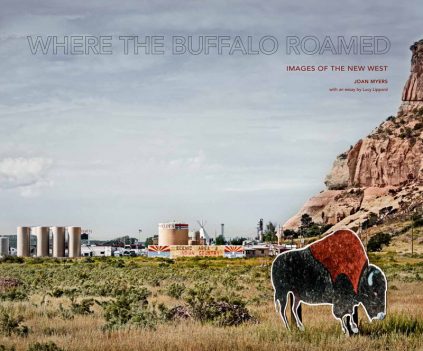
Where the Buffalo Roamed: Images of the New West

In this latest collection of photographs, taken over the last forty-five years, Joan Myers turns her lens to the contemporary American West. In so doing, she turns our conception of western landscapes and the life contained within them upside down, revealing the changes the region has undergone over the last half-century.

Her perspective is at once elegiac and ironic, capturing the myth and reality of the West, its shaping and appropriation by Hollywood, popular culture, and the ever-present, but fracturing American dream. A larger-than-life statue of a cowboy stands on the same lot with a 1960s Cadillac Coupe de Ville. A man in Wrangler jeans and a cowboy hat sits for his portrait on a dais with a Hopi maiden, cows, and deer made out of barbed wire in front of a curtain featuring a photograph of iconic cliffs and sky. A billboard buffalo stands in a field flanked by red rock cliffs on one side and oil refineries on the other with a sign announcing, “Scenic Areas—Indian Country.” A cardboard John Wayne-lookalike cowboy poses by a fence topped by saddles and a sign that says, “We accept all credit cards.”

In deconstructing the pictures, cultural critic Lucy Lippard notes that they “seem to emerge from cracks in American culture. They show us a past that still affects, and reflects, our present, revealing unexpected insights into how the myths of the West were formed and how they relate to reality.”

Fire Ghosts

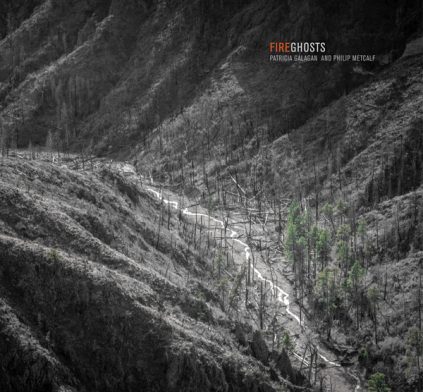
In the summer of 2011, in the Jemez Mountains of New Mexico, a falling power line sparked a wildfire that burned 158,753 acres of forest. From their home in Santa Fe, 30 air miles southeast, photographers Patricia Galagan and Philip Metcalf watched what came to be known as the Las Conchas fire burn day and night for more than a month.

As soon as the roads reopened, they went to the mountains to see the damage this violent fire had wrought. Taking a trail to the rim of Cochiti Canyon, they passed through sections of forest that had burned so hot nothing remained but blackened trunks and negative spaces where huge tree roots had been. The canyon and the waves of ridges beyond were black with standing dead trees.

The visual chaos of the burned forest, at first daunting, pushed them to look harder, see differently, and, as they did so, the forest began to look beautiful in its highly altered state. For more than seven years they were compelled to make photographs of the aftermath of the fire to draw people beyond the news-cycle images of smoke and flames into the reality of a forest after an extreme fire. FIRE GHOSTS is both their ode to the old forest, and their gift to help us understand that in this era of accelerating climate change and increasingly devastating wildfires all over the world, the new forests will never be the same, but we can still find beauty there.

Patricia Galagan’s photography often concerns the aftermath of upheaval in the landscape. Her work has been shown at Blue Sky Gallery in Portland, Oregon, the New Mexico Museum of Art, in Santa Fe, Fototeca de Cuba in Havana, and Fotografika Gallaery near Geneva, Switzerland, among others.

Philip Metcalf creates black-and-white infrared images of the landscape, most notably in the American Southwest. In 2015, he was an artist-in-residence at Bandelier National Monument in New Mexico with his wife, Patricia Galagan. His work has been shown at the New Mexico Museum of Art and the San Diego Art Institute.

Craig D. Allen is a specialist in system dynamics with the U.S. Geological Survey. William deBuys is a conservationist and author of eight books, including A Great Aridness: Climate Change and the Future of the American Southwest. Katherine Ware is curator of photography at the New Mexico Museum of Fine Art.

Florida’s Changing Waters: A Beautiful World in Peril

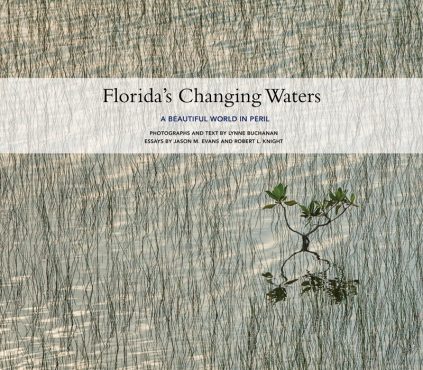
Lynne Buchanan began photographing rivers to create artistic records of her connection with water and the lessons she learned from rivers about being in the present moment and aligning with the flow of life. The more time she spent photographing waterways in her native Florida, the more she noticed what was being damaged and lost due to human impact. She resolved to work with water and environmental advocates, from members of the Waterkeeper organization to Native American activists fighting to preserve the integrity of their ancestral lands and drinking water and to draw attention to the situation through her photography.

The result is Changing Waters, which documents the negative effects of climate change, agricultural pollution, population and urban growth, and land development on Florida’s inland and coastal waters and springs. Though her work is very place specific, it reveals the interconnected and global nature of our environmental problems. Indeed, Florida, with its fragile springs, wetlands, and coastal waters, can be considered a tragic and powerful example of what is happening and will continue to happen to aquatic systems elsewhere in the nation and the world as a result of unchecked industrialization and human-caused climate change. Her images invite viewers to consider their personal relationship to water and encourage better stewardship of this vital––and finite––resource. They are also a call to action to find effective ways to preserve these waterways for both their natural beauty and their essential role in our survival.

Lynne Buchanan’s photographs have been featured in numerous solo and group exhibitions including the South Florida Museum in Bradenton, the Fogartyville Arts and Media Center in Sarasota, the Marie Selby Botanical Gardens in Sarasota, the Griffin Museum of Photography in Winchester, Massachusetts,

Brickworks Gallery in Atlanta, Georgia, and 516 Arts in Albuquerque, New Mexico. She has been affiliated with the Waterkeeper Alliance since 2013.

Robert F. Kennedy Jr., named one of Time magazine’s “Heroes for the Planet” for his work with Riverkeepers on behalf of New York’s Hudson River, has been a tireless defender of the environment across the Americas and beyond for more than 30 years. He is currently senior counsel to Waterkeepers Alliance, which operates throughout the United States and in more than 130 countries. He is the author of five books.

Robert L. Knight, Ph.D is an environmental scientist/systems ecologist with more than thirty-five years of experience as an aquatic and wetlands ecologist in Florida. He is the founder and director of the Howard T. Odum Florida Springs Institute, which is co-located with the North Florida Springs Environmental Center in High Springs, Florida.

Jason M. Evans, Ph.D is an interdisciplinary systems and landscape ecologist and assistant professor of landscape and environmental studies at Stetson University in Deland, Florida. He is currently working with local governments along the southeastern U.S. coast on sea level rise adaptation. He also has extensive experience in the ecology, management and restoration of Florida springs ecosystems.

1930: Manhattan to Managua, North America’s First Transnational Automobile Trip

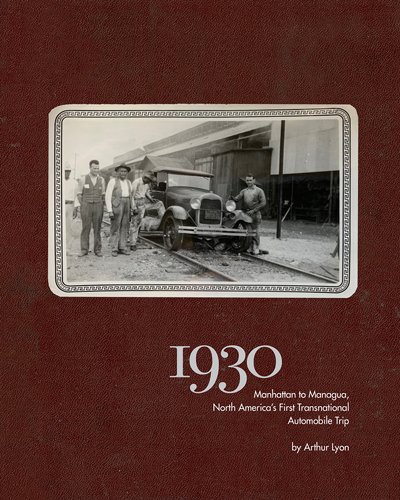
Imagine setting out on a road trip in a 1929 Ford Model A Roadster, with the stated goal of traveling from Manhattan to Mexico and Central America, after only a week’s worth of preparation. This is exactly what brothers Arthur Lyon (age 25) and Joe Lyon, Jr. (age 21) did on March 23, 1930. They prepared for the trip by purchasing camping gear, studying maps, gathering information about the areas they planned to traverse, getting their passports and credentials in order, mounted in the car’s rear seat a fifty-five-gallon oil drum equipped with a gas feed for extra fuel, and divided up the princely sum of $324 in cash to fund their sojourn. As for their Spanish? Muy poco (very little).

The story is replete with movie-like accounts of what the young men faced on their epic journey, including encounters with expatriates, government and military officials, and other characters. In Mexico, where they faced nearly impassible roads, they finally had the car fitted with extra railroad wheels so they could literally ride the rails south. The brothers’ 4,562-mile trip ended on May 17, 1930, their fifty-fourth day on the road, after the car suffered mechanical problems and the brothers and car nearly met their fate in the form of an oncoming freight train. Arthur and Joe returned to the U.S. separately, in part by tramp steamer.

The amazing 1930 journey of the young Lyon brothers—the first-ever transnational trip by car in North America—can be seen as the centerpiece of a larger story, of a pair of lives lived out not just as brothers but as partners who sought adventure and careers in the new Automobile Age. To help understand the forces that shaped those lives, the brothers’ nephew, Larry Lyon, provides an introduction that chronicles the family’s rich history, from a family-owned grist mill in southern Missouri to the small mining towns of Pearl, Idaho, and National, Nevada, to their father’s innovative auto-repair business in McDermott, Nevada, the brothers’ founding of Nevada’s first bus company their investment in oil and gas exploration, and many other business ventures.

Denis Wood, the renowned geographer, provides annotations to the brothers’ journey, highlighting geographic, historical, and current events of the time in the U.S., Mexico, and Central America. In the conclusion, Sally Denton, prize-winning investigative journalist and author, reminds us of how truly unique was the brothers’ journey and how it represents Americans’ true longing for exploration and adventure. Readers will no doubt appreciate the story as typifying some of the best of our unique American character.

Larry Lyon was born in 1947 in Reno, Nevada, and grew up in Reno and Boulder City, Nevada. He completed his B.A. in psychology at the University of Nevada, Las Vegas, and M.S. in experimental psychology and Ph.D. in clinical psychology, both at Washington State University. Since 1979, he has worked in the mental health field in a variety of settings, including nineteen years in private practice in The Dalles, Oregon. He currently works for the Veterans Health Administration in Las Vegas. He resides in Boulder City, Nevada.

Denis Wood was born and raised in Cleveland, Ohio, where he graduated from Western Reserve University with a B.A. in English. He received his M.A. and Ph.D. in geography from Clark University in Worcester, Massachusetts, where he subsequently taught high school. From 1973 until 1996, he taught environmental psychology and design at the College of Design at North Carolina State University, where he was Professor of Design and Landscape Architecture. Author of The Power of Maps (Guilford Press, 1992), he also curated the award-winning Cooper-Hewitt National Museum of Design exhibition of the same name (subsequently mounted at the Smithsonian Institution in Washington, D.C.). With Robert J. Beck, he co-authored Home Rules (The Johns Hopkins University Press, in association with the Center for American Places, 1994) about the transmission of culture that occurs in the process of “living a room.” The book was designated one of the top 100 geography books of all time by the Royal Geographical Society. His other book publications include Weaponizing Maps: Indigenous Peoples and Counterinsurgency in the Americas, with Joe Bryan (Guilford Press, 2015), Everything Sings: Maps for a Narrative Atlas (Siglio Press, 2010; Second Edition, 2013), Rethinking the Power of Maps (Guildford Press, 2010), The Natures of Maps: Cartographic Constructions of the Natural World, with John Fels (University of Chicago Press, 2008); Making Maps: A Visual Guide to Map Design for GIS, with John Krygier (Guilford Press, 2005; Second Edition, 2011; Third Edition, 2016); Five Billion Years of Global Change: A History of the Land (Guilford Press, 2004); and Seeing through Maps: The Power of Images to Shape Our World View, with Ward L. Kaiser and Bob Abramms (ODT, 2001; Second Edition, 2005). Wood also exhibits his artwork and lectures widely.

Sally Denton, born in Elko, Nevada, in 1953, is a third-generation Nevadan. She attended the University of Nevada-Reno before completing her B.A. at the University of Colorado in Boulder in 1974. Denton received a Nannan Literary Grant in 2000, Western Heritage Awards in 2002 and 2004, and a John Simon Guggenheim Memorial Foundation Fellowship in General Nonfiction in 2006. In 2008, she was inducted into the Nevada Writers Hall of Fame. Her career as an investigative reporter resulted in articles in The Washington Post, Penthouse, The New York Times, Columbia Journalism Review, and American Heritage. Her books include The Bluegrass Conspiracy: An Inside Story of Power, Greed, Drugs, and Murder, co-authored with Robert Samuel (Doubleday, 1990); The Money and the Power: The Making of Las Vegas and Its Hold on America (Alfred A. Knopf, 2001), which was made into a documentary film broadcast on the History Channel; American Massacre: The Tragedy at Mountain Meadows, September 1857 (Alfred A. Knopf, 2006); Passion and Principle: John and Jessie Frémont, the Couple Whose Power, Politics, and Love Shaped Nineteenth-Century America (Bloomsbury, 2007); The Plots Against the President: FDR, a Nation in Crisis, and the Rise of the American Right (Bloomsbury, 2012); and The Profiteers: Bechtel and the Men Who Built the World (Simon & Schuster, 2016). Denton currently resides in Boulder City, Nevada, and Santa Fe, New Mexico, and her Website is www.sallydenton.com.


BORDERLESS: The Art of Luis Tapia

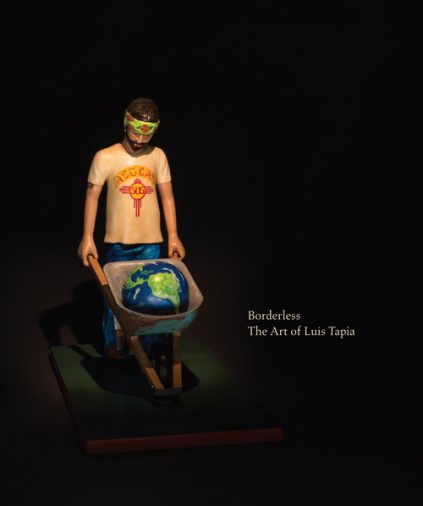
Sculptor Luis Tapia is a pioneering Chicano artist who for forty-five years has pushed the art of polychrome wood sculpture to new levels of craftsmanship and social and political commentary. Tapia’s insightful, accessible, sometimes controversial, and often humorous pieces reflect contemporary Hispano/Chicano life in New Mexico and beyond. At once an artist and activist, Tapia serves as a powerful spokesperson for his culture. At the same time, his work transcends his cultural surroundings and subject matter, informing and educating large audiences of non-Hispanic viewers about Chicano culture through the elegance of his carving and eloquent social commentary.

Tapia’s works have been acquired by private collectors and museums nationwide, including the Smithsonian Institution’s American Art Museum and American History Museum, El Museo del Barrio and Museum of American Folk Art in New York, Denver Art Museum, and the Autry National Center of the American West in Los Angeles. While his work has been reviewed and included in a variety of publications, this will be the first devoted to an examination of his long career. The essays by leading art historians, curators and literary figures will consider Tapia’s art both inside and outside the local and regional contexts in which it is made, and address its relevance and vitality within the broader national and international artistic conversation.

Luis Tapia regards his work as an extension of the Hispano folk art tradition that was established in New Mexico in the seventeenth century and has continued to evolve over 400 years. His art combines an innovative use of materials with commentary and humor on contemporary social, political and religious issues. Tapia’s work has ranged from updated representations of saints, serious examinations of crime, pedophilia, and the Catholic Church, to parodies of politics and everyday life. His meticulously carved and painted works employ familiar details of popular culture, such as cars, tattoos, golf courses, even one’s weekly laundry, to encourage viewers to examine their own feelings about religion and politics, or simply to laugh and be entertained. Among Tapia’s most popular images are his lowrider cars and life-sized “dashboard altar” installations, both of which explore religious themes within the context of contemporary car culture.

Denise Chávez is an award-winning novelist, short story writer, playwright, actor, and teacher whose work focuses on the border corridor of southern New Mexico, West Texas and Northern México, where she grew up and still lives. Her 1995 novel, Face of an Angel (Grand Central Publishing), won the American Book Award and Premio Aztlán of that year. The King and Queen of Comezón (University of Oklahoma Press, 2014) won the 2015 International Latino Book Award in Fiction and the 2015 New Mexico-Arizona Fiction Award. Chávez’s other books include Loving Pedro Infante (Washington Square Press, 2002); a memoir of her mother, A Taco Testimony: Meditations on Family, Food and Culture (Rio Nuevo, 2006); a short story collection, The Last of the Menu Girls (Vintage Books, 2004); and a children’s play, La Mujer Que Sabía El Idioma de Los Animals/The Woman Who Knew the Language of the Animals (Houghton Mifflin, 1993).

Dana Goia is an internationally acclaimed American writer and poet. Former chair of the National Endowment for the Arts (2003-2009), he is currently the poet laureate of the state of California. He is author of several poetry collections, all published by Graywolf Press, including 99 Poems: New & Selected (2016); Interrogations at Noon (2001), winner of the American Book Award; The Gods of Winter (1991); and Daily Horoscope (1986). His critical collections include Can Poetry Matter? Essays on Poetry and American Culture (Graywolf, 1992), which was a finalist for the National Book Critics Circle Award in criticism; Barrier of a Common Language: An American Looks at Contemporary British Poetry (University of Michigan Press, 2003); and Disappearing Ink: Poetry at the End of Print Culture (Graywolf Press, 2004).

Edward Hayes, Jr. is Curator of Exhibitions at the Museum of Latin American Art in Long Beach, California, where he has coordinated more than thirty exhibitions, including the international traveling exhibitions Frida Kahlo, Her Photos (2014) and 20th Century Masterpieces from the FEMSA Collection (2015); as well as Project Room: Marcos Ramírez ERREMagical Realism and Modern Oaxaca (2014); Neomexicanism (2014); Marcela Armas: Resistencia y Vórtice; Clarissa Tossin: Streamlined (2015); Korda: Revolutionary Photographer (2015); and MOLAA at Twenty: 1996 – 2016 (2016).

Lucy Lippard is an internationally known writer, activist, curator and author of twenty-four books on contemporary art and cultural criticism, including most recently Undermining: A Wild Ride through Land Use, Politics and Art in the Changing West (The New Press, 2014); Down Country: The Tano of the Galisteo Basin, 1250-1782, with photographer Edward Ranney (Museum of New Mexico Press, 2010); Mixed Blessings: New Art in a Multicultural America (Pantheon, 1990); and The Lure of the Local: Senses of Place in a Multicentered Society (The New Press, 1997). Recipient of nine honorary degrees, a Guggenheim Fellowship, and a Lannan Foundation Grant, among other awards, she lives off the grid in rural New Mexico, where for twenty years she has edited the monthly community newsletter, El Puente de Galisteo.

Tey Marianna Nunn is Director and Chief Curator of the Art Museum of the National Hispanic Cultural Center in Albuquerque, New Mexico. Previously, she spent nine years as Curator of Contemporary Hispano and Latino Collections at the Museum of International Folk Art in Santa Fe. She received her M.A. and Ph.D. in Latin American Studies from the University of New Mexico, her research focusing on Spanish Colonial, Contemporary Latin American, and Chicana/o and Latina/o art history and history.

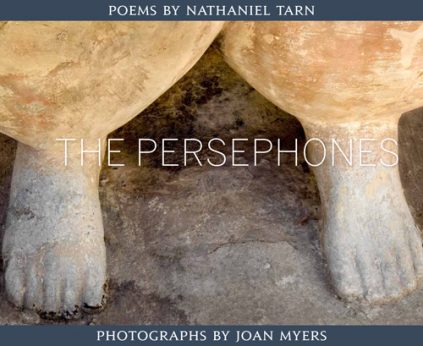
THE PERSEPHONES

In The Persephones, internationally known poet Nathaniel Tarn and photographer Joan Myers have collaborated on an elegant re-telling of the myth of Persephone’s abduction by Hades into the Underworld. First published in 1974, and again in 2009 in a limited, collector’s edition (both of which are out of print), these poems have attracted a devoted readership. This beautifully designed and produced edition at an affordable price pairs the poems with Myers’s stunning photographs, many of which were shot at the sites from which the myth originated.

Nathaniel Tarn (born 1928) is a British-born poet, essayist, translator, and former publisher whom Kenneth Rexroth has called “One of the most outstanding poets of his generation.” He has published some thirty books in his various disciplines and his work has been translated into ten languages. Joan Myers (born 1944) is the author of Fire and Ice: Timescapes (Damiani 2014). Her highly acclaimed work has been the focus of three Smithsonian exhibitions, more than fifty solo and eighty group shows, and eight books. Her work is held in the permanent collections of Bibliotèque National de Paris, Center for Creative Photography, and the Museum of Modern Art, among others.

VANISHING VERNACULAR: Western Landmarks

Steve Fitch has photographed examples of “vanishing vernacular architecture,” both ancient (petroglyphs) and modern (neon motel signs, drive-in movie theatre screens, and radio towers throughout the West) for the last forty-five years. Interestingly, as he points out in his essay that accompanies the book, the petroglyphs have endured far better and longer than anything made in the last sixty years. This fascinating and comprehensive volume presents over 100 images along with Fitch’s text, and an insightful essay by curator Toby Jurovics that looks at Fitch’s work in relation to that of the practitioners of the photographic style known as The New Topographics, and Fitch’s own view of it as a kind of cultural anthropology.

Steve Fitch has been a photographer since the early 1970s. He has taught at the University of Colorado at Boulder, Princeton University, and, most recently, at the College of Santa Fe and The Santa Fe University of Art and Design. He is the recipient of two National Endowment for the Arts Fellowships in 1973 and 1975, and the last National Endowment for the Arts Survey Grant, awarded in 1981. He is also the author of Diesels & Dinosaurs: Photographs From the American Highway (Long Run Press, 1976), and Gone: Photographs of Abandonment on the High Plains by Merril Gilfillan, Kathleen Howe, and Evelyn Schlatter (University of New Mexico Press 2002). His work is in the collection of the Smithsonian American Art Museum, among others.

Toby Jurovics is Chief Curator and Richard and Mary Holland Curator of American Western Art at the Joslyn Art Museum in Omaha, Nebraska. Previously, he was Curator of Photography at the Smithsonian American Art Museum and Associate Curator of Photography at the Princeton University Art Museum. He has organized exhibitions on Robert Adams, Lewis Baltz, Barbara Bosworth, Emmet Gowin, A. J. Russell, William Sutton, and William Wylie, among many other artists, and has written seminal essays on Thomas Joshua Cooper, John Gossage, and the New Topographics. He is the author of Framing the West: The Survey Photographs of Timothy H. O’Sullivan (Yale University Press, 2010).

Watch a clip about Vanishing Vernacular on BBC.

TIDAL RHYTHMS: Change and Resilience at the Edge of the Sea

Tidal Rhythms: Change and Resilience at the Edge of the Sea is a collaborative effort by photographer Stephen Strom and award-winning essayist Barbara Hurd. Strom’s images, taken along beaches in the Gulf of California and the Northern California and Oregon coasts, document a world teeming with ancient life-forms, clinging to rocks and finding nourishment but revealed for only a few hours before the tidal waters return. The primitive flora and fauna together create transient marine landscapes whose complex patterns resonate with what we humans perceive as beauty.

Following the rhythms of Strom’s images as they travel between intimate portraits and expansive vistas, Hurd’s lyrical and philosophical essays both continue and complicate those cadences as she explores not just resonance, but also disturbance. As artist and writer move us from high tide to low tide and from the panoramic to the minuscule and back again, the reader is confronted with the larger issues of what happens as the seas rises, warms, and acidifies. Tidal zones are one of the first landscapes to be threatened—almost invisibly—by global climate change. Mussels, barnacles, and tidal pools are flung and ruffled or warmed and acidified in ways that stress the lives of those who live there. Shells begin to thin, species migrate north, and habitats literally disappear, yet few people are even aware of these amazing environments.

Change, of course, is part of an ancient pattern. For billions of years, the sea has risen and fallen, and life-forms have managed to adapt or not. But the current pace of change confronts us with a new and urgent question: Can the long-established but delicately balanced worlds between tidelines evolve rapidly enough to enable continued sustenance and maybe even a new beauty? In Tidal Rhythms, we are given the gift of a new world-view.

DEATH VALLEY: Painted Light

Death Valley is the lowest, driest and hottest area in North America. Located about 150 miles west of Las Vegas near the border of California and Nevada, it straddles an area of about 3,000 square miles (7,800 km). A land of extremes and contrasts, it includes a mountain that towers over 11,000 feet, and an oasis that provides habitat for the endangered Devils Hole Pupfish (Cyprinodon diabolis). Designated a national park in 1994, its rugged, yet otherworldly beautiful landscape now attracts over 1 million visitors per year.

Attracted by the distinctive topography and light of Death Valley, Stephen Strom began traveling regularly there some thirty-five years ago.  His abstract, almost pointillist compositions reveal the patterns and effects of geologic forces over millennia, taking in both the vast sweep of land and sky and the details of the volcanic cinder cones, sand dunes, dry lakes and salt pans, colorful badlands and canyons, and pine-studded mountains that give the area its distinctive and varied character.

His images are complemented by Alison Hawthorne Deming’s sequence of poems that are as luminous and detailed as the images themselves. Rebecca Senf’s perceptive essay situates his work within the canon of those who have inspired and mentored him, including Ansel Adams, Harry Callahan, Keith McElroy, Eliot Porter, Frederic Sommer, and Max Yavno.

Stephen Strom is both a research astronomer and fine art photographer. His work, largely interpretations of landscapes, has been exhibited throughout the United States and is held in several permanent collections including the Center for Creative Photography in Tucson, Arizona, the University of Oklahoma Art Museum, the Mead Museum, Amherst, Massachusetts, and the Museum of Fine Arts, Boston. He has published six previous books of photography, including three with the University of Arizona Press, Secrets from the Center of the World, with Muscogee poet Joy Harjo (1989), Sonoita Plain: Views from a Southwestern Grassland, a collaboration with ecologists Jane and Carl Bock (2005), and Tseyi: Deep in the Rock Reflections on Canyon de Chelly, with Navajo poet Laura Tohe (2005).

Alison Hawthorne Deming is an award-winning poet and essayist. She is the author of eleven books of nonfiction and poetry, the most recent of which are Zoologies: On Animals and the Human Spirit (Milkweed, 2014) and Stairway to Heaven, forthcoming from Penguin in 2016. Her many awards include  the Walt Whitman Award of the Academy of American Poets, two National Endowment for the Arts Fellowships, a Wallace Stegner Fellowship at Stanford University (1987-1988), and a 2015 fellowship from the John Simon Guggenheim Foundation.  She is the Agnese Nelms Haury Chair of Environment and Social Justice at the University of Arizona, Tucson.

Rebecca A. Senf, PhD is the Norton Family Curator of Photography, a joint appointment at the Center for Creative Photography, and the Phoenix Art Museum. Her recent exhibitions include Debating Modern Photography: the Triumph of Group f/64, Richard Avedon: Photographer of Influence, Edward Weston: Mexico, Face to Face: 150 Years of Photographic Portraiture, and Exposing Time: Capturing Change Through Photography. Senf is the author, with Stephen J. Pyne, of Reconstructing the View: The Grand Canyon Photographs of Mark Klett and Byron Wolfe (University of California Press, 2011).

THE ARTISTIC ODYSSEY OF HIGINIO V. GONZALES: A Tinsmith and Poet in Territorial New Mexico

Higinio V. Gonzales (1842-1921) was more than a gifted metalworker. A man of varied talents whose poems and songs complement his work in punched tin, Gonzales transcends categorization.  In this book, Maurice M. Dixon, Jr., who has spent more than thirty years studying New Mexico tinwork, describes the artist’s signature techniques. Recounting the scholarly detective work that revealed the full scope of Gonzales’s art and career, Dixon tells the story of this man who was a craftsman as well as a poet.  Featuring translations of Gonzales’s poetry, this award-winning book restores a long forgotten New Mexico innovator to the prominence he deserves.

Maurice Dixon is an artist and art historian based in Santa Fe whose work is included in the collections of the Museum of Spanish Colonial Art, The National Hispanic Cultural Center, and the New Mexico Museum of Fine Arts, among others, as well as in numerous private collections.  He has created works on paper and canvas and is also himself a tinsmith specializing in a variety of decorative architectural commissions for public and private entities.  He is co-author, with Lane Coulter, of the highly-regarded New Mexico Tinwork 1840-1940 (University of New Mexico Press).

Carmella Padilla is an award-winning journalist and author who writes about intersections in art, culture and history in New Mexico and beyond. She is of several books that examine New Mexico Hispano art and culture, including, with photographer Jack Parsons, Low ‘n Slow: Low Riding in New Mexico, and The Work of Art: Folk Artists in the 21st Century.

Alejandro Lopez, who translated Gonzales’s poems from Spanish into English is a Spanish-language translator based in Santa Cruz, New Mexico.

FIRE & ICE: Images from the Ends of the Earth

Joan Myers’s book, Wondrous Cold: An Antarctic Journey, was published by Smithsonian Books to wide acclaim, and the images were featured in an exhibition at the Smithsonian Institution in 2006. In FIRE AND ICE she adds volcanoes to the mix, with photographs of iconic sites from all over the world, including Volcano National Park on the island of Hawai’i, Lanzarote, in the Canary Islands, Cotopaxi and Picincha in Ecuador, Nevada del Ruiz in Colombia, Mt. Erebus in Antarctica, Krakatoa in Indonesia, and of course Mt. Etna and Pompeii. The work is breathtakingly beautiful, compelling, and provocative by turns. Her essay reads like an adventure story, exploring the connection between fire and ice while describing her thrilling treks to ends of the Earth.

from the author’s essay:

“We like to imagine Earth as a ball, a brightly-colored dime-store globe with countries and oceans drawn on its glossy surface. We forget that its surface slides, subducts, and transforms, setting off earthquakes and volcanic eruptions. Icy poles melt and then reform over geologic time, dramatically changing sea level. Fire and ice are animating forces for our planet, constantly changing its surface and atmosphere. . . . A stable earth, whatever we would like to think, is an illusion.

I am fascinated by what I cannot see and by what goes on beneath my feet. As a photographer, I struggle to comprehend the magnitude of these forces and changes by photographing volcanic activity and the enormous polar ice sheets. I want to photograph the evidence of geologic time and forces on our landscape. Between the extremes of fire and ice lies transformation . . . and the future of the human race.”

About Joan Myers:

Joan Myers has been taking photographs for more than thirty years, exploring the relationships between people and the land. Her highly acclaimed work has been the focus of three Smithsonian exhibitions, more than fifty solo and eighty group shows, and seven books. Her work is included in the permanent collections of the Amon Carter Museum, Bibliothèque Nationale de Paris, Center for Creative Photography, Denver Art Museum, George Eastman House International Museum of Photography, High Museum of Art, Minneapolis Museum of Art, Museum of Fine Arts, Houston, Museum of Modern Art, Nevada Museum of Art, and San Francisco Museum of Modern Art, among others. She lives outside Santa Fe, New Mexico. www.joanmyers.com.

About Kathleen Howe:

Kathleen Stewart Howe, PhD has curated over 100 exhibitions and been the author of several catalogues focused on the interplay of photography and culture. Since 2004 she has been the Sarah Rempel and Herbert S. Rempel ‘23 Director of the Pomona College Museum of Art and professor of Art History at Pomona College in Pomona, California. Her exhibitions at PCMA have featured artists John Divola, Edgar Heap of Birds, David Michalek, James Turrell, Frederick Hammersley, Kara Walker, and Enrique Chagoya. Her books include Excursions Along the Nile: The Photographic Discovery of Ancient Egypt (Santa Barbara Museum of Art 1994), which won a Krazna Kraus Foundation Award; and Felix Teynard: Calotypes of Egypt, (Hans P. Kraus, 1992) which was named a New York Times Notable Book in Photography in 1992.

MEMENTO MORI: Testament to Life

A poignant memorial to the victims of Colombia’s ongoing, armed conflict, the images in MEMENTO MORI: Testament to Life are at once majestic, accessible, and deeply moving.  The book consists of three bodies of work: Drifting Away, images of articles of clothing of “the disappeared,” photographed in water and embedded in glass; Sudarios or shrouds, photographs printed on linen of women who have witnessed atrocities committed against their loved ones; and Relicarios, three-dimensional works of polymer containing mementos and personal effects of the victims.

Accompanied by hauntingly beautiful images of the work at exhibitions and in memorials in areas where the victims were “disappeared,” as well as by essays exploring its social and political implications, this book is a significant resource in contemporary Latin American studies, as well as for social anthropologists, human rights workers, and those wanting to understand at a very basic level the human cost of terrorism.

Erika Diettes is a Colombian visual artist and social anthropologist who explores issues of memory, pain, absence and death in a variety of mediums. Her work has been exhibited in unique spaces linked to re-memoration processes developed by the victims’ movements in Colombia, as well as at other venues including the Museums of Modern Art of Bogotá, Cali, Medellín, and Barranquilla in Colombia; the Museum of Contemporary Art in Santiago de Chile, at the Museum of Fine Arts and the Fotofest Biennal in Houston, the Festival de la Luz in Buenos Aires, the Ballarat Foto Biennale in Australia, the Malta Festival in Poznań, Poland, and at CENTER in Santa Fe, New Mexico.  Her work is part of the permanent collection of the Museo de Antioquia (Colombia) and the Museum of Fine Arts Houston.

Anne Wilkes Tucker was the Gus and Lyndall Wortham Curator of Photography of the Museum of Fine Arts, Houston from 1976, when she founded the department, until her retirement in June 2015.  While at MFAH she organized or co-organized more than forty exhibitions, including retrospectives on Brassaï, Louis Faurer, Robert Frank, George Krause, Ray K. Metzker, Richard Misrach and, most recently “WAR/PHOTOGRAPHY:  Images of Armed Conflict and its Aftermath,” and expanded the museum’s photographic holdings from 141 images to more than 29,000, representing work by some 4,000 artists from all seven continents. In 2001, she was named America’s best curator by TIME magazine.

Ileana Diéguez, PhD is a research professor in the Humanities and Social Sciences Department at Universidad Autónoma Metropolitana (UAM) in Mexico City, where she works on issues of modern and performing arts, as well as the processes pertaining to performativity and disassembly. She has curated exhibitions on these themes in Mexico and South America, and is the author of several books including Cuerpos sin duelo. Iconografías y teatralidades del dolor/Bodies Without Mourning. Iconographies and Theatricalities of Pain (Document A, 2013), and Escenarios Liminales. Teatralidades, performances y política/Liminal Stages/Scenarios. Theatricalities, Performances and Politics (Atuel 2011).

IRELAND: One Island, No Borders

Ireland is a place of mystical, enduring appeal for many, including the millions of Americans who claim its heritage—over one-sixth the current U.S. population, according to the latest census. IRELAND: One Island, No Borders presents the country as seen through the eyes of one of its most famous and passionate sons, Gerry Adams, the renowned leader of Sinn Fein, and Elizabeth Billups, a Santa Fe-based photographer and activist who fell in love with the country of her ancestors. This unique collaboration reveals the Ireland not always seen in guidebooks, as well as a side of Adams not usually captured in the news.

Adams shares personal anecdotes and family stories along with relevant historical details, legends, and myths, complemented by Billups’ photographs of their favorite places throughout the country, and impressions culled from her many visits. His essay provides a useful overview of Irish history and the long sequence of events that led up to “The Troubles.” His discussion of the historic Good Friday Peace Agreement, of which he was the primary architect, adds an important dimension to the text.

Gerry Adams has written over a dozen books. What makes this one unique is the focus on his deep love for his country, its beauty and its people, as well as on his steadfast political vision. Looking at this gorgeous volume and reading his text will make any reader understand why he has fought so long and so hard for peace and for a united Ireland—and why so many people the world over share his and Billups’s great love of Ireland.

Elizabeth Billups is a Santa Fe-based photographer, philanthropist, and political activist. She is currently on Nuclear Watch New Mexico’s steering committee and Alliance for the Earth’s Guiding Council. She is co-founder of Apsara Global Arts, a company that supports artists and weavers in Cambodia and Laos. Billups also has worked with the American Indian Movement, the International Indian Treaty Council, and Native American poet-activist John Trudell. Her photography has been exhibited in both the U.S. and Ireland.

Gerry Adams has been president of Sinn Fein, the largest all-Ireland party, since 1983. He served as a member of Parliament for West Belfast from 1983 to 1992 and from 1997 to 2011. Since then he has been the Teachta Dála or representative to the irish Parliament, the Dail, for Louth since 2011. Heralded as “a gifted writer” by The New York Times, he is the author of a volume of fiction, THE STREET AND OTHER STORIES, as well a several volumes of non-fiction, including A FARTHER SHORE: Ireland’s Long Road to Peace, which was published to wide acclaim by Random House in 2003. He is a native of Belfast.

Ireland_quote2

THE HOME STAGE

Though Jessica Todd Harper uses a camera rather than a paintbrush, the viewer quickly senses in her images the familiar canvases of Sargent, Whistler and Vermeer. Harper’s naturalistic images pause or recreate real life for the camera; the play between the often-formal environment and her subjects–intimately portrayed family members–creates images that seem at once intimate and artificial. Her latest collection is thus aptly called The Home Stage, a double entendre that references the home-bound lifestyle of families with small children as well as the idea that home is the stage on which children first learn to live. With her elegant compositions, unique color palette and skillful handling of light, Harper transforms every room and yard into a stage set. No detail is left untouched by her eye: even the wallpaper that recedes into darkness bears symbolic significance. Somehow both private and universal, Harper’s photography is genuine, tender, uninhibited and, at times, humorous, demonstrating the emotional range of the finest actor and director and drawing strong performances from her supporting cast–her husband, her children, her sister, extended family and friends. Harper’s photographs have been reviewed in The New Yorker, Photo District News, Camera Austria, the Frankfurter Allgemeine Zeitung and other publications, and she has taught at the International Center of Photography and Swarthmore College. Her first book, Interior Exposure, was published by Damiani to wide acclaim in 2008. She lives in Philadelphia.

ILUMINACIONES

How does a photographer learn to see? How does he create his own visual language—as unique as a fingerprint and as inimitable as the voice of a great writer?

In Iluminaciones, Jack Parsons’s seventeenth book, he takes the viewer on a very personal, deeply intuitive journey that reveals how he has honed his photographic vision. The answer is subtle—and remarkable: It is by growing into his own photographs. Here he shares with us ninety-one of his favorite photographs taken over the long arc of his stellar career. These are images that, over time, taught him, as he says, “to see the everyday world with new and better eyes,” and that encouraged him “to look deeply instead of glancing and forgetting.”

The photographs in Iluminaciones were taken all over the world, from the vast expanses of America’s desert Southwest to a mosque in Turkey and temples in Laos, Burma, and Japan, of colorful streets in Mexico and Italy to quiet swimming pools in Southern California, from monumental urban landscapes in Eastern Europe to clouds forming over Ireland and Maui. Most of the pictures are of simple, commonplace things that we might not give a second glance. Yet Parsons did and in so doing both reveals and celebrates the subtle power and quiet beauty of the everyday. Complemented by the artful commentary of Frederick Turner, Iluminaciones is a stunning visual exploration of the beauty that shines through our world if we take the time to stop and look.

Illuminaciones_quote2

Jack Parsons is well known for his elegant photography that captures the visual heritage of the American Southwest. His sixteenth and most recent book is Dark Beauty (available from George F. Thompson Publishing). In recognition of his contributions, he was honored in 2006 with the New Mexico Governor’s Award for Excellence and Achievement in the Arts. He lives in Santa Fe.
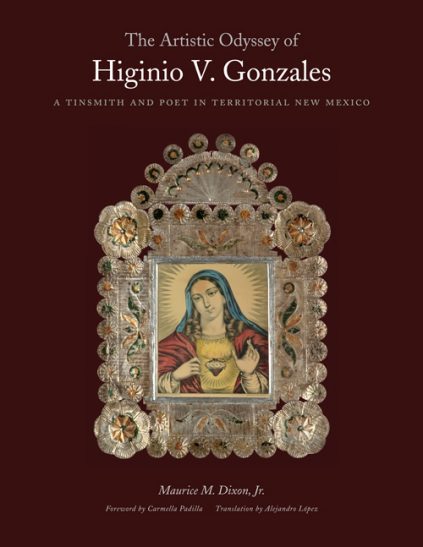
Frederick Turner is the author of twelve books of fiction and non-fiction, the latest of which is Henry Miller and the Making of ‘Tropic of Cancer‘ (Yale, 2012). The recipient of fellowships from the National Endowment for the Arts and the John Simon Guggenheim Memorial Foundation, he lives in Santa Fe.

HONORING THE DOUGHBOYS: Following My Grandfather’s World War I Diary

Honoring the Doughboys: Following My Grandfather’s World War I Diary is a stunning presentation of contemporary photographs taken by the author paired with diary entries written by his grandfather, George A. Carlson, who was a soldier in the U.S. Army during World War I. Lowdermilk followed his grandfather’s path through France, Belgium, Luxembourg, and Germany, and returned with these meticulously crafted photographs and his own engaging stories that bring the diary to life for contemporary readers.

Lowdermilk’s passion for World War I and military history began as a young boy when he listened to his grandfather tell his stories about serving as a foot soldier—a “doughboy”––in Europe during the Great War. When his grandfather passed away in 1982, Lowdermilk’s mother gave him her father’s diary, which included not only lengthy descriptions of the landscapes, towns, and battles he had experienced, but also keen observations and insights about life as a doughboy for Mr. Carlson and his buddies.

Lowdermilk became fascinated with the diary, first transcribing it, and then plotting his grandfather’s path through France, Belgium and Germany as part of the American Expeditionary Forces. He immersed himself in the history of World War I and its geography, eventually retracing, over a dozen years, the trajectory of his father’s journey.

This image-rich tour of European landscapes, battlefields, and monuments offers the reader an experience that is at once an intimate reliving of Carlson’s time as a doughboy, a lively collection of Lowdermilk’s travel anecdotes, and a moving expression of gratitude to American veterans of the Great War. The foreword by Helen Patton, granddaughter of General George S. Patton, Jr., adds an extra dimension to the narrative.

Jeffrey A. Lowdermilk is a writer, photographer, lecturer, and student of the First and Second World Wars. He has traveled extensively throughout Europe, documenting the path detailed in his grandfather’s World War I diary. He is the author of Saluting America’s World War I Heroes, a historical narrative and photography presentation that documents the eighty-seventh anniversary of the Armistice. He lives in Santa Fe, New Mexico, with his wife, Annie.

Helen Patton is the granddaughter of General George S. Patton, Jr., Chairwoman of the Patton Foundation, and the author of Portraits of Service: Looking into the Faces of Veterans. She lives in Reims, France.